
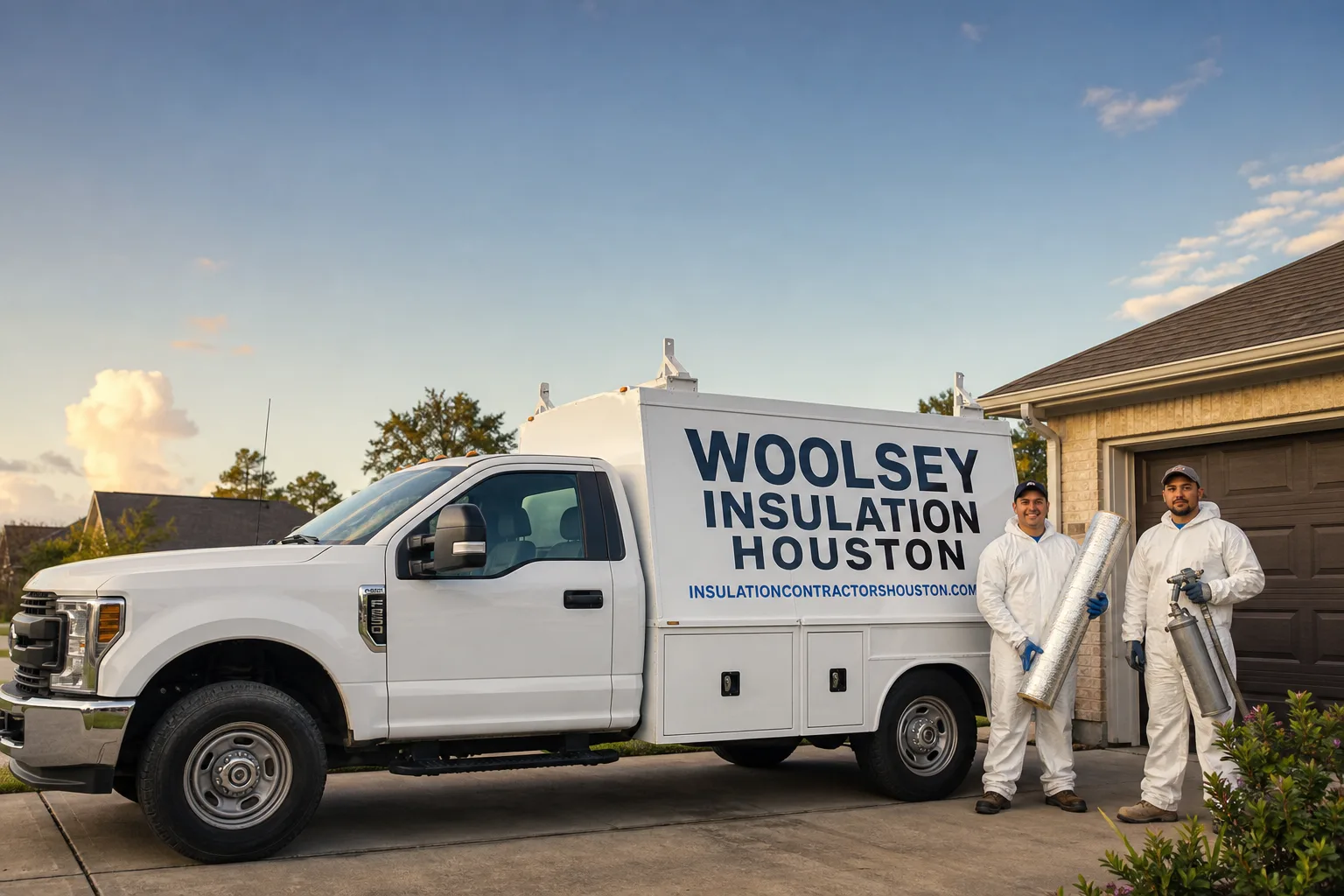
How Much Does Wall Insulation Cost in Houston?
Wall insulation in Houston typically costs between $1,800 and $6,200 for a standard single-family home, with most homeowners paying around $2.75 to $4.50 per square foot of wall area. The final number depends on the insulation type you choose, whether walls are open during construction or need to be accessed through existing drywall, and how much of your home you’re insulating. At Woolsey Insulation Houston, every job gets a written price before any work starts, so you’ll know your exact number up front, not an estimate that shifts at the door.
Houston’s climate makes wall insulation a different conversation than it is in Minnesota or Michigan. We’re not fighting sub-zero winters here. We’re fighting a humidity problem that runs from April through October. The right wall insulation slows heat gain during those long Gulf Coast summers, and it does something just as important: it blocks moisture from moving through your walls into conditioned space. That moisture is what makes a Houston house feel sticky at 72 degrees when the AC is running full blast.
Wall Insulation Cost Breakdown (2026)
Here’s what Houston homeowners are paying for wall insulation in 2026, broken down by insulation type and application method. These are real market ranges based on the jobs we quote and install across the metro area, from Meyerland to The Woodlands to Katy.
- Blown-in fiberglass (open walls): $1.40 – $2.25 per square foot of wall area
- Blown-in cellulose (open walls): $1.50 – $2.40 per square foot
- Fiberglass batts (open walls, new construction): $0.90 – $1.80 per square foot
- Spray foam, open-cell (open walls): $2.75 – $4.25 per square foot
- Spray foam, closed-cell (open walls): $3.50 – $5.75 per square foot
- Injection foam (existing closed walls): $2.50 – $4.00 per square foot
- Blown-in dense-pack (existing closed walls): $2.00 – $3.50 per square foot
To put that in real-house terms: a 2,000 square foot Houston home has roughly 1,600 to 2,000 square feet of exterior wall area. Insulating those walls with open-cell spray foam runs about $4,400 to $8,500. Blown-in fiberglass in the same walls runs $2,200 to $4,500. Injection foam in existing walls for that same house: $4,000 to $8,000.
The wide ranges exist because no two Houston homes are built the same way. A 1960s ranch in Sharpstown with 2×4 framing and no existing wall insulation is a different job than a 2015 build in Bridgeland that already has builder-grade batts and just needs an upgrade. We’ll get into what moves the number in the next section.
What Affects Wall Insulation Pricing in Houston
Wall insulation pricing moves based on a handful of factors, most of which are specific to how Houston homes were built and how our climate behaves. Here’s what we look at when we write a quote.
- Wall access: If you’re already down to studs for a remodel, insulation costs drop by 40 – 60% compared to fishing material into closed walls. Closed-wall work requires drilling access holes in each stud bay, filling, then patching. The material cost is similar, but the labor is double or triple.
- Framing depth: Most Houston homes built before 1990 use 2×4 walls, which only hold R-13 to R-15 worth of batt or blown-in material. Newer 2×6 construction holds R-19 to R-23. Spray foam changes the math here because it seals air as well as insulates, so a 2×4 wall with closed-cell foam can outperform a 2×6 wall with fiberglass.
- Insulation type and R-value: Closed-cell spray foam costs more per inch than open-cell or blown-in products, but it delivers roughly double the R-value per inch. In Houston’s humidity, closed-cell also acts as a vapor retarder, which matters in walls that see daily moisture drive from outside air.
- Home age and existing material: Pre-1960s Houston homes in neighborhoods like the Heights or Montrose often have no wall insulation at all, or degraded material that’s settled into a thin band at the bottom of each cavity. Removing old material and starting fresh adds labor but is often the only way to get a real result.
- Access and obstructions: Pier-and-beam homes common in Bellaire and West University give access from below, which sometimes makes wall work easier. Slab foundations in most suburban Houston neighborhoods mean everything happens from the interior or exterior wall face. Plumbing, electrical, and framing obstacles inside cavities add time to every stud bay.
- Seasonal demand: Houston insulation work peaks from May through September when the heat is relentless and AC bills spike. Booking in October through March often comes with slightly better scheduling flexibility, though our pricing stays consistent year-round.
Wall Insulation Types: What You’re Actually Paying For
You don’t need to become an insulation expert to make a good decision, but knowing the basic differences between materials will help you understand why one quote is $2,200 and another is $6,000. Here’s how the major wall insulation options work in the Houston climate.
Fiberglass Batts
Fiberglass batts are the pink or yellow rolls you see in every home improvement store. They’re cheap, easy to install in open walls, and fine for what they are. The problem: batts only perform at their rated R-value if they’re cut and fitted perfectly around every wire, outlet box, and pipe. In real-world installations, batt insulation loses 20 – 30% of its effectiveness from gaps and compression alone. For Houston homeowners on a tight budget with open walls, this is the entry point. Batts from Owens Corning, Johns Manville, and Knauf are what we install in these cases.
Blown-In Fiberglass and Cellulose
Blown-in insulation comes as loose fibers that get pneumatically packed into wall cavities. In open walls, installers net the cavities and blow the material to a consistent density. In closed walls, we drill holes in each stud bay and dense-pack the material. Cellulose, made from recycled paper treated with borates, performs better than fiberglass in Houston’s humidity because it can absorb and release moisture without losing its insulating value. GreenFiber is the cellulose brand we use most. Blown-in fiberglass from Owens Corning and CertainTeed is the other half of that equation.
Spray Foam: Open-Cell and Closed-Cell
Spray foam insulation is a two-part liquid that expands on contact and seals gaps airtight. Open-cell foam is softer, lighter, and less expensive. It expands aggressively and does a great job filling irregular cavities, but it’s permeable to moisture. Closed-cell foam is denser, harder, and roughly twice the cost per board foot. It creates an air barrier, provides structural strength to the wall, and acts as a vapor retarder, which matters in Houston where outdoor humidity levels sit above 70% for half the year.
For Houston wall applications, we typically recommend either closed-cell foam for maximum moisture control or dense-packed cellulose for a budget-conscious option that still performs well in our climate. The right answer depends on your wall depth, your home’s age, and whether you’re dealing with existing moisture concerns. Icynene and Demilec are the spray foam systems we install, and they behave a little differently. Demilec’s closed-cell products deliver higher R-value per inch. Icynene’s open-cell foams expand more aggressively for filling odd cavities. Rockwool insulation rounds out our material options for fire-resistant and sound-dampening wall applications, especially useful in townhome and condo party walls.
How Much Does Wall Insulation Cost by Home Size in Houston?
Most Houston homeowners want a realistic number for their specific house, not a per-square-foot abstraction. Here’s what wall insulation costs look like across common Houston home sizes, assuming existing closed walls and dense-packed cellulose or injection foam.
- 1,200 sq ft home (about 1,000 sq ft of wall area): $2,000 – $4,000
- 1,800 sq ft home (about 1,500 sq ft of wall area): $3,000 – $6,000
- 2,500 sq ft home (about 2,000 sq ft of wall area): $4,000 – $8,000
- 3,500 sq ft home (about 2,800 sq ft of wall area): $5,600 – $11,200
These numbers assume standard 8-foot ceilings. Homes with 9- or 10-foot ceilings in newer developments like Towne Lake or Cinco Ranch have proportionally more wall area per square foot of floor space, so costs run 12 – 25% higher than the ranges above.
For open walls during new construction or a gut renovation, knock those numbers down by roughly 40 – 60%, depending on the material you pick. Batts in an open 2×4 wall are the cheapest wall insulation you can buy. Closed-cell foam in an existing 2×6 wall is the most expensive. Everything else falls in between.
Wall Insulation vs. Attic Insulation: Where Should Houston Homeowners Spend First?
If your budget is limited and you’re deciding between wall insulation and attic insulation in Houston, here’s the honest answer: attic first. Heat rises, and in a Houston summer, your attic can hit 140°F or hotter. That heat radiates down through your ceiling into the living space all day long. Attic insulation delivers faster payback per dollar spent than wall insulation because the temperature difference between your attic and your living room is far greater than the difference between outdoor air and your wall cavities.
That said, walls matter. A Houston home with well-insulated attic space but uninsulated walls will still lose cooled air through its walls around the clock. The walls are the largest surface area of your home’s thermal envelope. Once the attic is handled, wall insulation is the next biggest energy lever you can pull. Most of our Houston customers do attic first, then walls within a year or two as budget allows.
Houston Energy Savings: What Wall Insulation Actually Returns
Wall insulation isn’t just an upfront cost. It’s a monthly bill reduction that compounds for as long as you own the house. In Houston, where cooling dominates the energy bill for seven to eight months a year, properly insulated walls typically reduce annual cooling costs by 15 – 25% compared to uninsulated walls. On a home spending $2,400 a year on electricity, that’s $360 to $600 back in your pocket annually. Over a decade, wall insulation pays for itself twice over.
The catch: savings depend on the whole thermal envelope. Walls without attic insulation won’t fix the problem. Windows, air sealing, and duct condition all factor in. But walls are a major piece of the puzzle, and in a Houston house built before 1990, the walls are often the weakest link after the attic.
Houston Building Codes and Wall Insulation Requirements
Houston sits in climate zone 2A under the IECC (International Energy Conservation Code), which sets minimum insulation requirements for new construction. Current code for zone 2A calls for R-13 in wood-framed walls. That’s the minimum, and minimum isn’t a target. Most of the 1960s and 1970s homes all over Houston’s inner loop and older suburbs have zero wall insulation, because code didn’t require it when they were built.
If you’re adding wall insulation to an existing home, Houston’s building department doesn’t require a permit for insulation work alone. If the insulation is part of a larger remodel that touches structural elements or changes wall assemblies, your contractor needs the right permits. We handle insulation scopes directly, and we’ll tell you honestly if your project needs a permit before we touch anything.
The Kingswell Way: How Wall Insulation Jobs Run at Woolsey
Here’s what a wall insulation project looks like when you call Woolsey Insulation Houston. First, we schedule an assessment. One of our background-checked, uniformed technicians walks the home, measures the wall area, checks existing insulation if any, and discusses your goals. You get a written price after that visit. Not an estimate range, not a “we’ll see how it goes” number. A written price, every single time, before any work starts.
On the day of the job, we show up in the committed arrival window. Not a four-hour “sometime between” window. A real window we honor. The crew covers floors and work surfaces, drills access holes if the walls are closed, installs or injects the insulation, and patches those holes when needed. We leave the job site cleaner than we found it. Every job includes a written guarantee on the workmanship and materials for 365 days. If something isn’t right within that year, we come back and fix it at no charge. That’s the Kingswell Guarantee, and it’s included on every project, including our full range of Houston insulation services.
Glenn Hartley leads our Houston operation. He’s the person who reviews your quote before it goes out, and he’s the one you’ll hear from if anything about the project needs attention after the fact.
How to Save on Wall Insulation in Houston
Wall insulation is a real investment, but there are legitimate ways to bring the number down without cutting corners on performance.
- Bundle attic and walls together: If you’re planning to insulate both eventually, doing them in the same job reduces our mobilization cost and typically saves 10 – 15% compared to scheduling them separately.
- Choose your material based on your walls, not marketing: If you have 2×4 walls with open cavities, dense-packed cellulose does the job well at a fraction of closed-cell foam’s cost. Don’t pay for R-value you can’t physically fit into the cavity.
- Schedule during the cooler months: Houston’s insulation companies are busiest from late spring through early fall. October through March is easier to book and sometimes comes with more scheduling flexibility.
- Check for utility rebates: CenterPoint Energy and Entergy Texas have offered weatherization rebates in recent years, though program availability changes. Ask us during your assessment and we’ll point you toward anything currently active.
- Get a real written price: The biggest “savings” in home insulation is avoiding the door-step price change that cheap contractors pull. A written quote that matches the final bill means you’re not paying hidden fees. Call (903) 447-8369 for a free estimate and you’ll see the number before you commit.
Should You DIY Wall Insulation in Houston?
For open walls during a renovation, installing fiberglass batts is a weekend job an experienced DIYer can handle. The material is readily available, and you’re not dealing with the risk of leaving hidden voids in closed cavities that’ll haunt your energy bills later. But for closed walls, injection foam and dense-packed cellulose require commercial equipment and real technique. Underfilling cavities is common with DIY attempts, and you won’t know the insulation is inadequate until your AC bill shows up. In Houston’s climate, where humidity is the enemy, a poorly insulated wall can also become a condensation point. That’s a mold risk you don’t want to discover behind drywall two years from now. For closed-wall work, hire a crew that does this every day.
FAQs – Wall Insulation Cost in Houston
How much does it cost to insulate walls in a 2,000 sq ft house in Houston?
For a 2,000 square foot Houston home with existing closed walls, expect to pay $4,000 to $8,000 depending on the material. Blown-in fiberglass or cellulose runs toward the lower end of that range. Injection foam runs higher. If the walls are open for a remodel, that same project drops to roughly $1,800 to $4,500. Call (903) 447-8369 for an exact written quote on your house, free of charge.
Is wall insulation worth it in Houston’s climate?
Yes. Wall insulation in Houston typically cuts cooling costs 15 – 25% annually, which on a home spending $2,400 a year on electricity means $360 to $600 in savings every year. The insulation also helps control indoor humidity, which is a daily comfort factor in Houston that goes beyond the AC bill. Most homeowners recover their investment within 5 to 10 years.
What’s the cheapest way to insulate walls in Houston?
Blown-in fiberglass into open walls is the lowest-cost option at $1.40 to $2.25 per square foot. For existing closed walls, dense-packed cellulose is the most economical professional option at $2.00 to $3.50 per square foot. The key is that the installation is done correctly. Underfilled cavities in Houston’s humid climate mean wasted money and potential condensation problems later.
How long does wall insulation last in Houston?
Fiberglass batts and blown-in materials last 30 to 50 years when installed correctly and kept dry. Cellulose holds up similarly, though it can settle slightly over decades and lose a few R-value points. Closed-cell spray foam effectively lasts the life of the house. Houston’s high humidity doesn’t shorten insulation lifespan if the material stays dry, which is why proper installation matters.
Can you insulate existing walls without removing drywall?
Yes. Injection foam and dense-packed cellulose both go into existing walls through small access holes drilled in each stud bay, either from the exterior or interior wall face. The holes are patched afterward. Expect to pay $2.00 to $4.00 per square foot for this type of work in Houston.
Get Your Written Wall Insulation Price
You don’t have to guess what wall insulation will cost on your Houston home. Woolsey Insulation Houston gives you a written price before any work starts, every single time. Call (903) 447-8369 and a live person answers, 24 hours a day, 7 days a week. We’ll schedule an assessment, walk the home with you, and hand you a number you can take to the bank. No door-step surprises, no voicemail maze, and a 365-Day Done Right Promise in writing on every job. Glenn Hartley and the team are ready when you are.
Pricing reflects the Houston market as of 2026. Woolsey Insulation Houston offers free estimates – call (903) 447-8369.
Written by Glenn Hartley, Owner at Woolsey Insulation Houston, serving the Houston metro area since 2002.
What Our Customers Say
"Our old insulation was flattened and basically useless. They removed it, cleaned up, and blew in new. Furnace isn't running constantly anymore and the first bill already showed it."
- Carl Yeung"Good work and a fair price on spray foam in the garage. The crew did track a bit of the old insulation through the garage, but they vacuumed it up before they left. Garage is way warmer now."
- Brenda Falk"The guy didn't try to sell me on foaming the whole house. He said the attic was where I'd actually feel it and left it at that. Honest, and he was right, our bills dropped."
- Angela Ruiz