
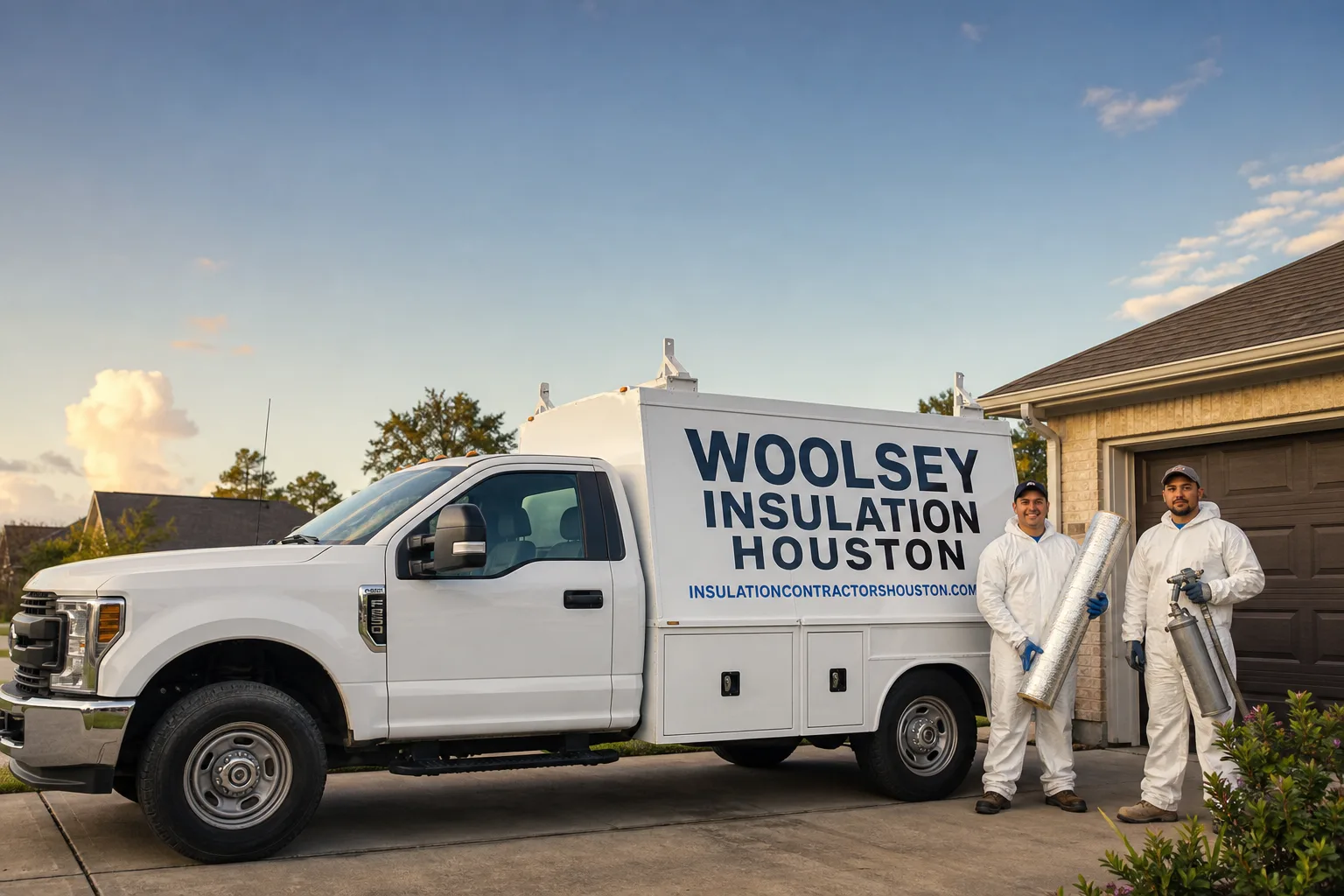
How Much Does Insulation Cost in Houston?
Most Houston homeowners pay between $1,600 and $3,900 for a standard attic insulation upgrade, with whole-home spray foam projects running $4,000 to $12,000 depending on square footage and accessibility. The Houston market sits slightly below the national average for blown-in fiberglass and cellulose, largely because our mild winters keep recommended R-values modest compared to northern climates. Woolsey Insulation Houston gives you a written price before any work starts, so the number you see is the number you pay.
Insulation Cost Breakdown (2026)
Here’s what we’re quoting in Houston this year. These figures reflect real jobs across the metro, from Pearland to Cypress to Kingwood.
| Insulation Type | Typical Cost Range (Houston, 2026) | Best For |
|---|---|---|
| Blown-in fiberglass (attic, R-30 to R-38) | $1,400 – $2,800 | Most attics, quick installation, good coverage |
| Blown-in cellulose (attic, R-30 to R-38) | $1,600 – $3,200 | Tighter air seal, recycled material, humid climates |
| Fiberglass batt (attic or walls) | $1,200 – $2,600 | Open attics, new construction, DIY replacements |
| Spray foam, open-cell (attic roof deck) | $3,800 – $7,500 | Unvented attics, air sealing, humidity control |
| Spray foam, closed-cell (attic roof deck or walls) | $5,000 – $12,000 | Maximum R-value per inch, moisture barrier |
| Air sealing + insulation bundle | $2,200 – $4,800 | Older Houston homes with leaky attics |
Those ranges include labor and materials. What pushes a job toward the top end? Attic access. If your attic has a narrow scuttle hole, low clearance, or ductwork running everywhere, the crew works slower and the job costs more. The bottom end usually applies to single-story homes with open attics and easy access.
One number worth knowing: Houston’s climate zone (Zone 2) calls for R-30 to R-38 in attics. If a contractor tries to sell you R-60, you’re paying for material you don’t need here. Woolsey works with eight leading brands; Owens Corning, Johns Manville, Knauf, Rockwool, CertainTeed, Icynene, Demilec, and GreenFiber; so material selection is driven by your home’s actual needs, not whatever happens to be on the truck.
What Affects Insulation Pricing in Houston
- Attic square footage. The single biggest cost driver. A 1,200-square-foot attic runs less than a 2,000-square-foot attic, plain arithmetic on material volume.
- R-value target. Most Houston homes need R-30 to R-38. Going higher costs more per square foot. Going lower than R-30 violates code for new work and won’t pass inspection.
- Access and attic condition. Tight scuttle holes, low roof pitch, existing ductwork, and old wiring all slow installation. If we have to remove old, compressed insulation first, that adds labor.
- Air sealing needs. In neighborhoods like The Heights and Montrose with 1920s-1950s bungalows, the air leaks in the attic floor are often the real problem. Adding air sealing before insulation adds $600 to $1,500 but typically pays for itself within two years on AC bills.
- Spray foam vs. traditional. Closed-cell foam costs two to three times more per board foot than blown-in fiberglass. It is a different product for different problems: sealing an unvented attic, adding structural rigidity, or handling moisture issues in a humid Gulf Coast climate.
- Seasonal demand. Houston insulation work slows slightly in winter and spikes in April through September. Scheduling in the shoulder months (October, March) sometimes gets you faster dates, though our pricing stays steady year-round; you get the same written quote in July that you would in January.
Key Takeaways
- Standard attic insulation in Houston costs $1,600 to $3,900 for most homes.
- Spray foam runs $3,800 to $12,000 depending on open-cell vs. closed-cell and square footage.
- R-30 to R-38 is the right target for Houston’s climate; anything higher is usually overspend.
- Air sealing before insulating makes the insulation work dramatically better in our humidity.
- Written pricing, not estimates, should be the norm. If a contractor won’t commit in writing, walk.
How to Save on Insulation in Houston
Insulation is one of the few home improvements that pays you back monthly. Cutting cost without cutting corners comes down to a few practical moves Houston homeowners actually use.
Start with air sealing. In Houston, the gap between a $1,600 insulation job and a $1,600 insulation job that actually changes your electric bill is air sealing. Seal the attic floor penetrations; around can lights, plumbing vents, wire chases, the attic hatch; before blowing insulation over them. Insulation traps heat, but air leaks carry humidity and heat through regardless. We bundle air sealing with most attic jobs in older Houston neighborhoods because we see what happens when customers skip it: they call a year later asking why their upstairs still runs hot.
Check for rebates before you commit. CenterPoint Energy and Entergy Texas have run insulation rebate programs in different years, and some municipal utilities in the Houston area offer similar incentives. The programs change frequently. Call your utility provider and ask about attic insulation rebates. We’ll also note current programs on your written quote when they exist.
Don’t over-insulate. A contractor pushing R-49 or R-60 in Houston is selling you something you don’t need. The Department of Energy recommends R-30 to R-38 for our climate zone. Beyond that, the marginal energy savings shrink to almost nothing. Spend the extra budget on air sealing instead; it delivers more comfort per dollar in Gulf Coast humidity.
Consider blown-in over batt for retrofits. If your attic already has some insulation and you’re topping it off, blown-in fiberglass or cellulose covers irregular spaces faster and cheaper than cutting batt to fit between every joist. The material cost is lower, and the coverage is more uniform.
Get the written price before you schedule. This one is less about saving money and more about not losing it. The Kingswell Way runs like this: we say the price up front, we show up in the committed arrival window, we leave the job site cleaner than we found it, we put the guarantee in writing, and if the work fails within 365 days we come back and fix it at no charge. A verbal estimate that “depends on what we find” is how door-step price changes happen. Our written price is delivered before any work starts, every single time, no exceptions.
Call (903) 447-8369 for a free estimate. We’ll walk your attic, measure the square footage, and hand you a number you can take to the bank.
What Does Insulation Cost by Houston Neighborhood?
Pricing shifts slightly depending on your home’s age and construction style. Here’s what we see across the metro:
Katy, Cypress, Sugar Land (1990s-2010s builds)
These newer suburbs typically have R-30 already installed and just need a top-up to R-38 or air sealing around the attic hatch and can lights. Jobs run $1,300 to $2,200. The homes are uniform, access is good, and the work goes fast.
The Heights, Montrose, East End (pre-1960 builds)
Older homes need full air sealing plus insulation, and the attics are often cramped with old knob-and-tube remnants or low clearance. These jobs run $2,500 to $4,500 depending on square footage and what we find under the existing insulation. In these homes, the air sealing matters more than the insulation itself.
Pearland, Friendswood, Clear Lake (1970s-1980s builds)
These houses often have original cellulose that’s settled to half its stated depth. Full removal and re-insulation runs $2,000 to $3,800. The humidity near Galveston Bay makes moisture resistance worth considering here; closed-cell spray foam on the roof deck is a common upgrade request.
Kingwood, The Woodlands, Spring (wooded lots, high humidity)
These areas see more roof-deck spray foam jobs because homeowners deal with persistent upstairs heat and attic moisture. Open-cell foam on the roof deck in a 1,800-square-foot attic runs $5,500 to $8,500. The shade from pine trees keeps the ground floor cool, but the attic still bakes and radiates heat downward all afternoon.
Is Insulation a Good Investment in Houston?
Short answer: yes, and here’s the math from the Houston market. The average Houston home spends about $1,700 to $2,200 per year on electricity, and cooling accounts for the majority of it from May through September. A properly air-sealed and insulated attic cuts cooling costs 15 to 20 percent on typical single-story homes, which means $260 to $440 back in your pocket annually.
At a $2,200 insulation cost, you’re looking at a five-to-eight-year payback in pure energy savings. But the real return shows up sooner. Upstairs rooms stop feeling like ovens in August. The AC cycles less, so the unit lasts longer. Humidity in the house drops, which makes 78 degrees feel comfortable instead of clammy. And if you sell the home, upgraded attic insulation is one of the few improvements appraisers actually note.
Houston is brutal on attics. Summer attic temperatures regularly hit 140 to 150 degrees. That heat radiates through your ceiling into living spaces all evening. A properly insulated attic with air sealing keeps that heat up there instead of baking your hallway at midnight. Glenn Hartley has walked hundreds of Houston attics since 2002 and the story is consistent: homes built before 1990 are almost universally under-insulated for what our summers now demand.
How Does a Woolsey Insulation Job Run?
You call. A live person answers, 24 hours a day, 7 days a week. No voicemail maze, no call-back window. You’ll schedule a free estimate, and a background-checked, uniformed technician shows up in the committed window.
We walk the attic. We measure square footage, check existing insulation depth, inspect the air sealing situation, and look at access and ductwork. Then we write you a price. Not a range, not a “we’ll see,” a fixed number in writing before any work begins.
On install day, the crew arrives in uniform, lays down floor protection, and gets to work. The job site gets vacuumed and checked before they leave. The Kingswell Guarantee covers every job: a written price before work starts, a committed arrival window, a clean job site, a written guarantee on the work, and a free return visit if any repair fails within the guarantee period. 365 days. In writing. Included on every job.
Wool was the first insulation. Woolsey keeps the idea in the name. We’ve been doing attic and spray foam insulation since 2002, as part of the Kingswell family of independently owned and operated insulation companies, and the guarantee has stayed the same the whole time: if it is not done right, we make it right, in writing, at no charge.
FAQs – Houston Insulation Cost
How much does blown-in attic insulation cost in Houston?
Blown-in fiberglass or cellulose for a standard Houston attic runs between $1,400 and $3,200 in 2026, depending on square footage, depth, and whether air sealing is included. Most homes in the metro fall right around $1,800 to $2,500 for a complete R-38 upgrade. Call (903) 447-8369 for a written quote; the estimate is free and the number is fixed before any work starts.
Is spray foam worth the extra cost in Houston?
Spray foam costs $3,800 to $12,000 compared to $1,600 to $3,200 for blown-in, so the answer depends on your attic. If you have an unvented attic, a room over the garage that never cools, or persistent humidity problems, foam on the roof deck solves problems fiberglass cannot touch. For standard vented attics with good airflow, blown-in plus air sealing gets you 90 percent of the benefit at a third of the price.
Can you install insulation the same week I call?
Most Houston jobs can be scheduled within 5 to 10 business days after the estimate, and we answer the phone 24/7 if you need to check availability right now. The free estimate visit usually takes 45 minutes, and we’ll leave you a written price before we leave the driveway.
Is it cheaper to insulate in winter in Houston?
Our pricing does not change seasonally. The written quote you get in July is the same number you would get in January. Demand does spike in summer, which affects scheduling speed more than price. If you want faster dates, early spring and fall typically have more openings.
Does Houston require a permit for insulation work?
Most attic insulation jobs in Houston do not require a standalone permit, but if the work includes structural changes to the attic, such as converting to a foam-sealed unvented attic, you may need one. The City of Houston and surrounding municipalities each have their own rules, and we handle permit paperwork when a job requires it. Your written quote will say explicitly whether a permit is included.
How long does attic insulation take in a typical Houston home?
Most standard attic insulation jobs are finished in a single day, 4 to 8 hours depending on square footage and access. Air sealing plus insulation in an older home may extend to a second day. We commit to an arrival window before the job and keep it.
Get Your Houston Insulation Price in Writing
You deserve to know the exact number before you commit a dollar. Call (903) 447-8369 and we’ll schedule a free estimate at your Houston-area home. A background-checked technician walks the attic, measures what needs measuring, and hands you a written price. No door-step surprises, no vague ranges, no pressure. Just the number, the guarantee in writing, and the home comfort you are paying for.
Pricing reflects the Houston market as of 2026. Woolsey Insulation Houston offers free estimates – call (903) 447-8369.
Written by Glenn Hartley, Owner at Woolsey Insulation Houston, serving Houston since 2002.
What Our Customers Say
"Good work and a fair price on spray foam in the garage. The crew did track a bit of the old insulation through the garage, but they vacuumed it up before they left. Garage is way warmer now."
- Brenda Falk"The guy didn't try to sell me on foaming the whole house. He said the attic was where I'd actually feel it and left it at that. Honest, and he was right, our bills dropped."
- Angela Ruiz"Spray foam in the crawlspace and new attic insulation. They wrote up the whole price and the two jobs came in exactly as quoted. Floors upstairs aren't freezing in the morning anymore."
- Nathan Pruitt